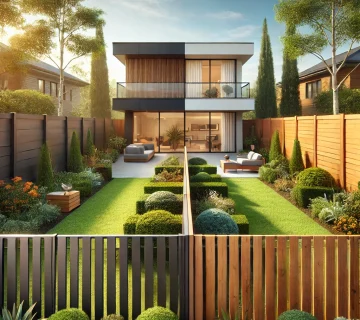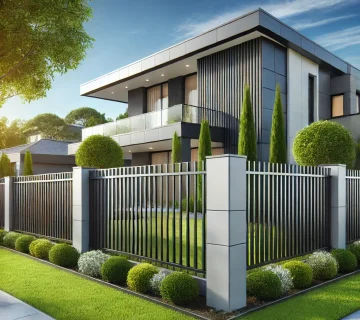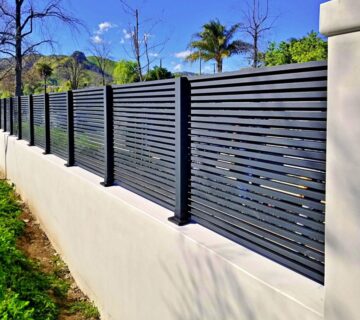
An aluminum fence on a slope can look clean and continuous, or it can end up with uneven tops, awkward gaps and gates that drag on the grade. The difference comes down to planning: measuring the slope properly, choosing between racked and stepped sections, and setting posts that stay put through an Ontario winter.
This guide covers each of those decisions for sloped yards, side yards and commercial sites. It is written for contractors, builders and property owners planning a project with aluminum fence panels and gates, and it applies whether the grade is a gentle roll or a steep bank.
Why an Aluminum Fence on a Slope Needs Extra Planning
On flat ground, a fence is a series of identical sections. On a grade, every section sits at a slightly different elevation, and small errors add up quickly. A 25 mm mistake at the first post can become a visible step or gap by the end of the run.
Slopes also change how the fence looks from the street, how gates swing and how bylaws measure height. That is why an aluminum fence on a slope should be laid out on paper first, with the grade measured, before any posts are ordered or holes are dug.
Fall is a good time to plan an aluminum fence on a slope in the GTA. The ground is still workable, grass is short, and the full shape of the slope is easier to see than in mid-summer.
Measure the Grade Before You Order
Every decision about an aluminum fence on a slope starts with the numbers. You need to know the total length of the run and how much the ground drops from one end to the other.
How do you measure the slope for a fence?
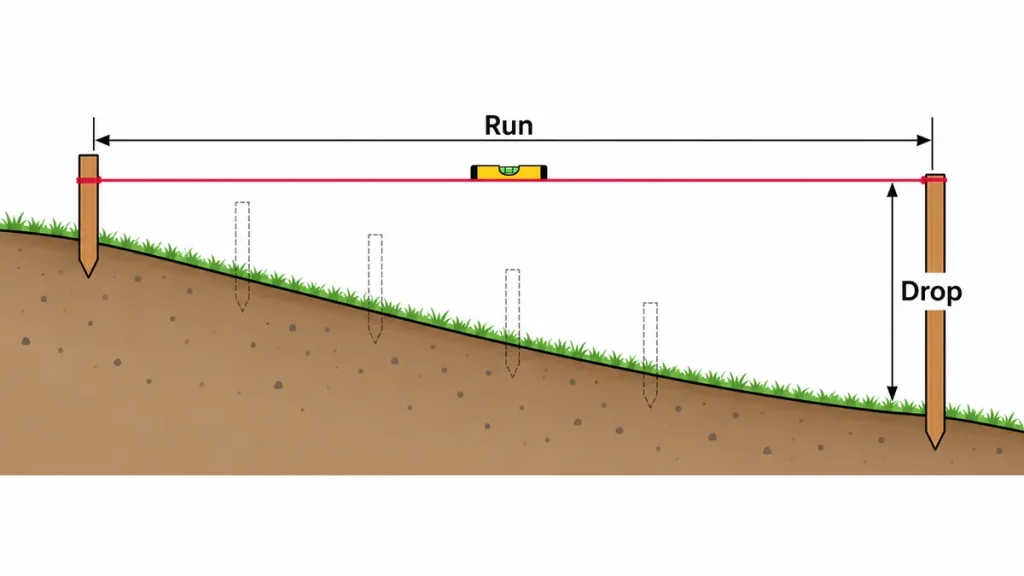
Drive a stake at the high end and another at the low end of the fence line, run a string between them, and level it with a line level. The distance from the string down to the ground at the low stake is the total drop; the length of the string is the run.
Divide the drop by the number of sections to estimate the rise per section. For example, a 12 m run with a 960 mm drop, divided into eight 1.5 m sections, works out to about 120 mm of change per section. On irregular ground, measure at each planned post location instead of relying on one average.
Record dips, humps, retaining walls, trees and changes in direction along the planned line of your aluminum fence on a slope. Our existing guide to aluminum fence installation in Toronto covers general layout, while the rest of this article focuses on the grade itself.
Racked vs Stepped Fence: Which Works for Your Slope?
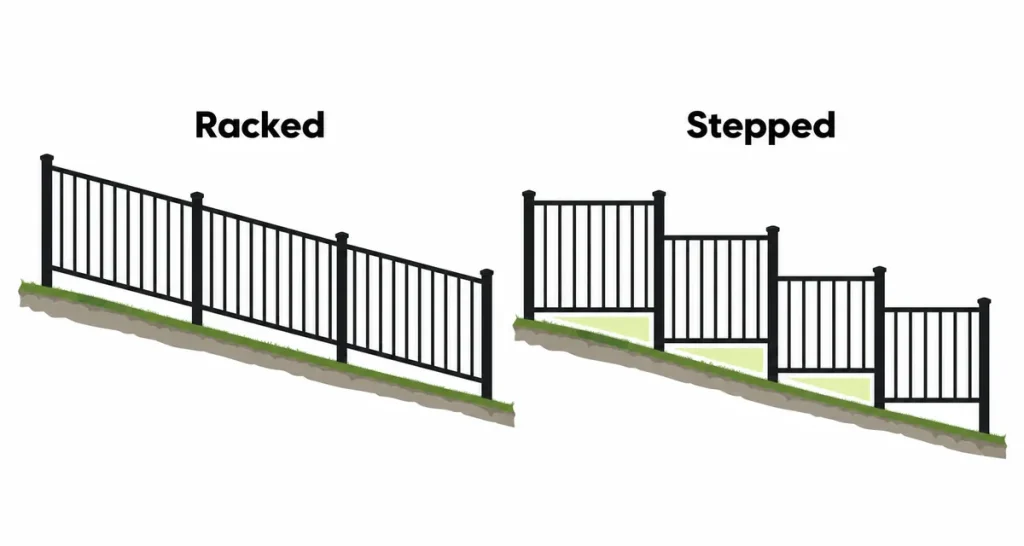
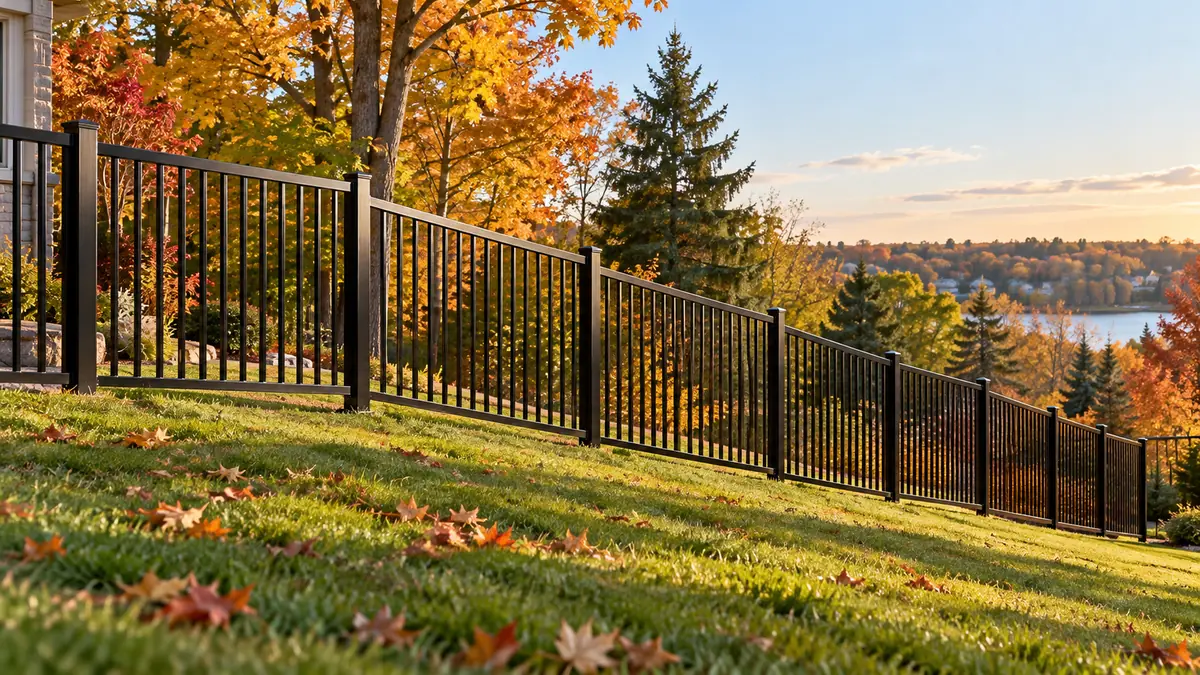
There are two main ways to build an aluminum fence on a slope. A racked section is angled so its rails run parallel to the ground while the pickets stay vertical. A stepped section stays level, and each section is set higher or lower than the last, like a staircase.
| Factor | Racked fence | Stepped fence |
|---|---|---|
| Appearance | Smooth line that follows the ground | Staircase profile along the top |
| Gap under the fence | Even along the run | Triangular gaps at the low end of each section |
| Best on | Gentle, consistent grades | Steeper grades or abrupt changes |
| Posts | Standard lengths in most cases | Longer posts on the downhill side |
| Pets and pools | Easier to keep gaps small | Gaps may need filling or extra panels |
Many projects use both methods on the same aluminum fence on a slope. A long backyard run might be racked across a gentle grade, then stepped where the ground drops sharply near a retaining wall.
Can aluminum fence panels follow a slope?
Many can, within limits. How far a section can rack depends on the specific panel design and how the pickets connect to the rails, so check the system before assuming it will follow your grade.
Custom fabrication helps here. When an aluminum fence on a slope is measured on site and built to that measurement, sections can be made to suit the actual ground instead of being forced to fit. Our fence system data sheet notes that measurements are taken on the job site before fabrication.
How steep is too steep for a racked fence?
There is no single number, because each panel design has its own racking limit. Once the rise per section passes that limit, the pickets start to lean or the rail connections are overstressed, and stepping or custom fabrication becomes the better choice for an aluminum fence on a slope.
Ask for the racking limit in millimetres of rise per section and compare it with your measurements. If only a few sections exceed it, those can be stepped or built to suit while the rest of the aluminum fence on a slope stays racked.
What do you do with the gap under a stepped fence?
The usual fixes are to regrade slightly under each section, add a gravel or stone border, or plant along the low edge. On a larger gap, a custom-height section or an extra bottom rail can close the space.
Address the gap during planning, not after. Pets, small children and pool rules all make an open triangle under the fence more than a cosmetic issue.
Posts and Footings for an Aluminum Fence on a Slope
Posts carry everything, and on a grade they work harder. Soil on a slope can be loose, wet or prone to washing out, and frost heave in a GTA winter can lift a post that is set too shallow. That movement shows up quickly on an aluminum fence on a slope, because one lifted post throws off the line of every section beside it.
Alumiguard’s fence posts are set into the ground with concrete. The total post length is the fence height plus the length buried in the ground, so on a stepped aluminum fence on a slope, the downhill posts need extra length to reach the higher section on one side while staying fully embedded on the other.
A few habits keep posts stable on sloped ground:
- Measure embedment from the ground at the post, not from a string line above it.
- Keep post holes plumb, even when the ground around them is angled.
- Slope the top of the concrete so water runs away from the post.
- Check for drainage paths that could wash soil away from downhill footings.
Before any digging, request a utility locate. Ontario Dig Authority, formerly Ontario One Call, says locates are free and required before you dig, including for fence projects. It asks for at least 5 business days’ notice for a single address, and private lines such as gas to a BBQ or power to a shed need a separate private locate.
Retaining Walls and Sudden Grade Changes
Not every sloped lot is a smooth lawn. Many GTA properties have retaining walls, concrete steps or landscaped terraces along the property line, and each one changes how the fence is attached.
Where the fence runs along the top of a retaining wall, posts may need to be wall-mounted or set back from the edge so the footings do not load the wall. Where the fence crosses a sudden drop, a custom section or a short stepped transition usually looks cleaner than forcing a racked panel past its limit.
Check who owns the wall and whether it is in good condition before attaching anything to it. A leaning or cracked retaining wall needs attention before it becomes the base for a new fence.
Gates on a Sloped Lot
Gates are where an aluminum fence on a slope most often goes wrong. A gate that swings toward the uphill side will hit the ground partway through its arc.
Place gates on the flattest part of the run where possible. If a gate must sit on a grade, plan for it to swing downhill, leave enough clearance under the gate for the full swing, or level a small pad in front of it.
Keep the gate frame level even if the fence on each side is racked. A racked gate can sag and bind over time, and latches work best when the gate sits square to its posts.
Bylaw Height and Pool Rules on Sloped Ground
Slopes also affect how height is measured. Under Toronto’s fence bylaw (Municipal Code Chapter 447), fence height is measured at any point along the fence from the average grade level, taken perpendicular to the fence and one metre away on either side.
On an aluminum fence on a slope, that means the downhill side of a stepped section can measure taller than you expect. The bylaw’s table sets limits by location; for example, 1.2 m for a front-yard fence within 2.4 m of a lot line along a public street, and 2.0 m for many other residential fences. The City’s fences bylaw page summarizes these rules, and other GTA municipalities have their own bylaws.
Can a stepped fence be used around a pool?
Only if the gaps are dealt with. Toronto measures a pool enclosure’s minimum height from the highest outside grade within one metre of the enclosure, and requires the non-climbable facing to start no more than 50 mm above grade.
The triangular openings a stepped section leaves on a slope can conflict with those rules. Our Toronto pool fence requirements guide explains the full list, including gates and permits.
Common Mistakes With an Aluminum Fence on a Slope
Most problems with an aluminum fence on a slope trace back to a handful of planning errors.
- Ordering before measuring. Standard sections rarely suit a grade without some adjustment.
- Using one average slope. Real ground has dips and humps that a single number hides.
- Short downhill posts. Stepped sections need extra post length on the low side.
- Gates on the steepest spot. This guarantees clearance problems.
- Ignoring height rules. The low side of a stepped section can exceed bylaw limits.
- Skipping the locate. Utility strikes are dangerous and costly, and the locate is free.
If you are still choosing a material, our comparison of aluminum fence vs vinyl fence explains how each handles uneven ground, maintenance and gates.
Planning an Aluminum Fence on a Slope With AlumiguardMFG
A well-built aluminum fence on a slope follows the ground without looking forced. It starts with accurate grade measurements, a clear choice between racked and stepped sections, posts set for the downhill side, and gates placed where they can swing freely.
AlumiguardMFG manufactures aluminum fence panels and gates in our North York facility for contractors, builders, developers and wholesalers across Toronto and the GTA. Our fence systems use 6063-T5 aluminum extrusions with a powder-coated finish in seven standard colours, in heights from 36 to 60 inches.
Send us your site measurements, the total drop, gate locations and preferred style, then contact AlumiguardMFG for a quote on an aluminum fence on a slope built for your exact grade.