

Indoor stair railings do two jobs at once. The handrail gives you something solid to hold on the way up and down, and the guard stops a fall off the open side of the stair or landing. Whether you’re fixing a wobbly staircase railing or choosing an indoor railing for a renovation, the right design depends on who uses the stairs, what the Ontario Building Code asks for and the look you want.
This guide covers the types of indoor stair railings, the code basics for interior stairs, safe railing design for children and older adults, why railings come loose, and when to repair or replace. It applies to the aluminum railing systems and glass railings AlumiguardMFG manufactures for homes and commercial buildings across Toronto and the GTA.
Handrail vs Guard: What an Indoor Stair Railing Includes
People often use “railing” for everything on a staircase, but the code treats two parts differently:
- The staircase handrail is the rail you grip while climbing. It can be mounted on the wall or run along the top of the guard.
- The guard is the barrier along the open side of the stair, landing or upper floor. It is the panel, pickets or glass that stops a fall.
A stair against a wall may only need a handrail, while a stair with an open side needs a guard as well. When a handrail sits on top of a guard, it has to work as both. Our guide to guards vs handrails explains the difference in more detail.
Types of Indoor Stair Railings
Most interior stair railings in Ontario homes and offices fall into a few families. Each can be paired with a wood or metal handrail.
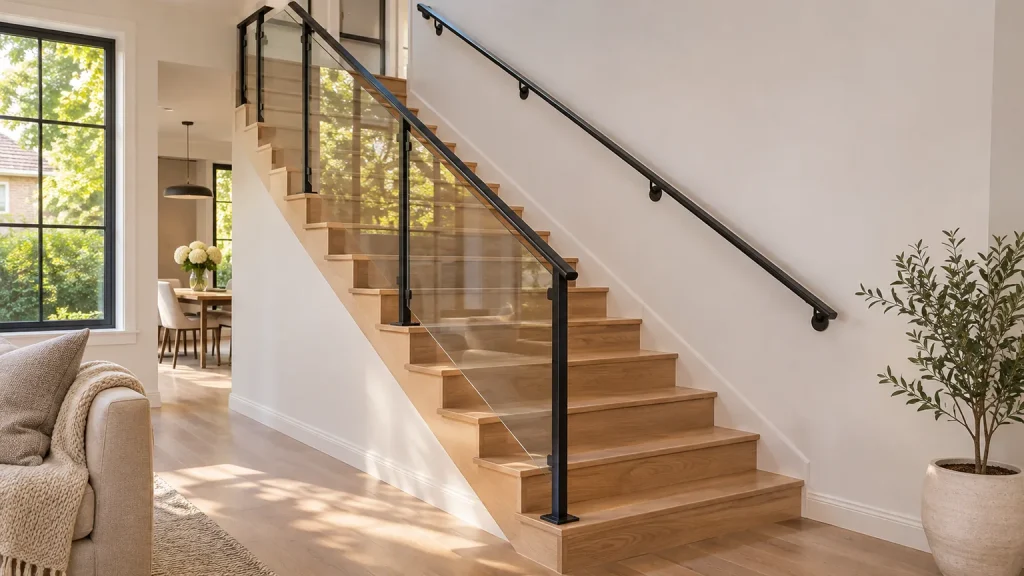
Glass stair railings
Glass panels keep a stair open and let light reach the hallway or the floor below. Panels can be held by slim aluminum posts and clips, or set in a frameless system with a shoe or standoffs. Glass in a guard must be safety glass, and thickness depends on the system and the span. See our glass railings and our guide to glass railing thickness.
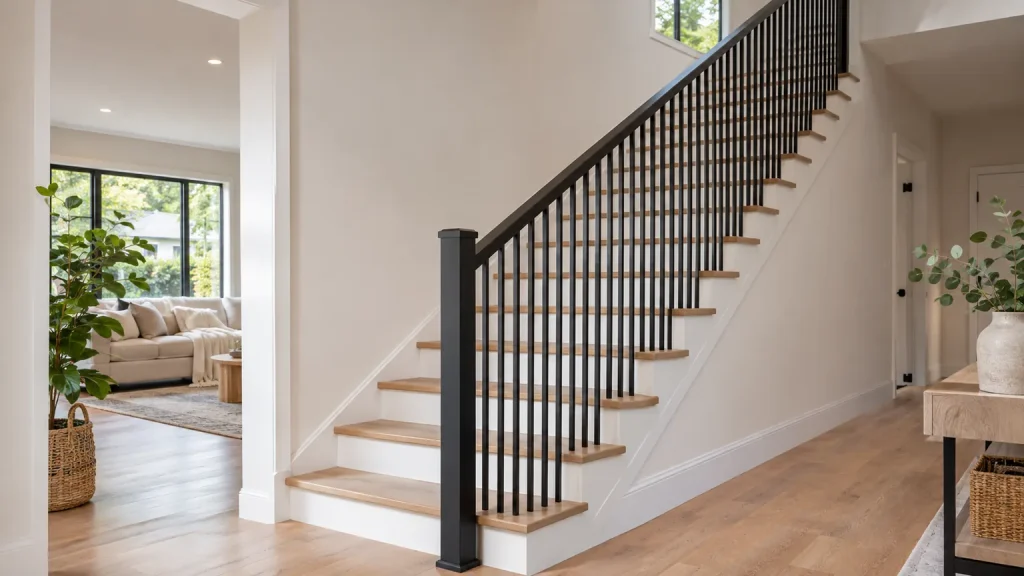
Aluminum picket railings
Vertical pickets are the most common indoor railing for family homes. They are sturdy, easy to clean and hard to climb. Our picket system uses ¾” pickets spaced 3¼” on centre, with powder-coated finishes in White, Warm Beige, Black, Clay, Commercial Brown, Charcoal and Cashmere.
Decorative metal railings
Decorative panels and scrollwork suit traditional homes and grand foyers. Aluminum versions give the look of wrought iron without rust. Browse our decorative railings for styles.
| Railing type | Look | Upkeep | Watch for |
|---|---|---|---|
| Glass with aluminum posts | Open and modern | Wipe glass; little else | Fingerprints in busy homes |
| Frameless glass | Most open; almost no visible metal | Wipe glass; check fittings | Engineering and precise installation |
| Aluminum pickets | Clean lines, many colours | Very low; no painting | Picket spacing on older or custom designs |
| Decorative metal | Traditional or ornate | Low with aluminum | Shapes that create footholds or large gaps |
| Wood balusters | Warm, classic | Refinishing; joints loosen over time | Loose balusters and newel posts |
Ontario Building Code Basics for Interior Stair Railings
The Ontario Building Code sets the rules for stairs, handrails and guards, and the 2024 edition changed some of them. These are the points that matter most for interior stair railings in houses. Your municipality’s building department has the final word, and some renovations need a permit.
Handrails
- Height: staircase handrail height is measured vertically from a line through the stair nosings, and the code sets both a minimum and a maximum. Many residential handrails sit at about 900 mm (35½ in.).
- Continuously graspable: under the 2024 code, required handrails must be graspable along each flight from the bottom riser to the top riser. In a house, the handrail may start from a newel post or volute on the bottom tread. Outside single homes, at least one handrail must also continue through the landings. The Municipality of Trent Lakes’ 2024 code change guide illustrates this change.
- Space behind wall rails: the same guide notes the 2-inch space behind a wall-mounted handrail, which also eats into the usable width of a narrow stair.
Guards
- Height: inside a house, guards along stairs and landings are generally at least 900 mm high. Many guards in commercial and multi-unit buildings must be 1,070 mm.
- Openings: gaps between pickets or panels must be less than 100 mm, and pickets must resist being pushed wider than that. The triangle formed by a tread, a riser and the bottom rail of the guard must not let a 150 mm sphere through.
- Climbing: no member or attachment between 140 mm and 900 mm above the floor or stair may make the guard easy to climb. That is why horizontal “ladder” designs aren’t used on Ontario guards.
- Engineering: guards made of metal or glass usually need engineered design documentation for a permit. The Town of Halton Hills’ guide, based on the 2024 code, shows these guard rules and notes that a railing manufacturer should be able to supply the documentation.
Safe Railing Design for Children, Seniors and Everyone Else
Code is the minimum. Safe railing design looks at the people who actually use the stairs.
- Children: vertical pickets or glass leave nothing to climb, and tight spacing keeps heads, arms and toys from slipping through. Avoid planters, shelves or furniture next to the guard that create a step up.
- Older adults: Health Canada’s fall-prevention guide notes that falls are the leading cause of injury among older Canadians and recommends solid handrails on both sides of the stairway. A second, wall-mounted handrail is an easy upgrade.
- A handrail you can actually grip: a round or rounded profile that a hand can wrap around is safer than a wide flat cap.
- Visibility: good lighting at the top and bottom of the stair, and a handrail colour that contrasts with the wall, help people with low vision.
- No snag points: handrail ends should return to the wall or post so sleeves and bag straps don’t catch.
Why Indoor Railings Become Loose
A shaky staircase railing usually has a simple cause:
- Brackets screwed into drywall instead of studs or solid blocking.
- A loose newel post. Years of people swinging around the bottom post work the joint loose.
- Seasonal wood movement. Dry, heated winter air shrinks wood balusters and handrails, so joints that were tight in summer can rattle by January.
- Worn fasteners and anchors, especially in older stairs or on stone and concrete steps.
- Glass fittings that were never fully tightened or have shifted over time.
Fix or Replace a Loose Stair Railing?
Repair makes sense when the railing is sound and only the connections have worked loose. Re-securing brackets into framing, tightening a newel post or re-fixing a few balusters is often enough.
Replace when:
- Posts are cracked, split or rotted at the base.
- The guard is lower than today’s minimum, or the gaps between balusters are wide enough for a child to slip through. This is common in older homes.
- Repairs keep failing in the same spot.
- You’re renovating the stair, flooring or hallway anyway.
A new railing has to meet the current code, not the one in force when the house was built. Measuring the stair, landings and floor edge accurately is the first step; our guide to railing shop drawings explains what to check before anything is fabricated.
How to Choose the Right Indoor Stair Railing
- Who uses the stair? Young children and older adults point toward tight picket spacing or glass, plus a second handrail.
- How much light do you want? Glass keeps a stairwell bright; pickets give more definition.
- What does it attach to? Wood stringers, concrete stairs and finished floors each need different mounting. Top-mounted and face-mounted posts both work indoors.
- What finish suits the house? Match the handrail and posts to window frames, door hardware or light fixtures. Our article on choosing a railing colour can help.
- Is the quote complete? Compare like with like, including posts, handrails, glass type and installation. See how to compare railing quotes.
For more design ideas, browse our article on modern interior railings and our look at interior glass railings.
Indoor Stair Railing FAQs
How high should an indoor stair railing be?
In a house, guards are generally at least 900 mm high, and handrails are measured from the line of the stair nosings, often at about 900 mm. Commercial and multi-unit buildings often need taller guards. Confirm the exact figures for your project with your building department or railing supplier.
Do I need a handrail on both sides of the stairs?
Many house stairs only require one, but a second handrail is one of the most effective safety upgrades for older adults and young children, and Health Canada recommends handrails on both sides.
Can I use glass for an indoor stair railing?
Yes. Glass guards use tempered or laminated safety glass and need a system designed for the span and loads. A graspable handrail is still needed along the stair.
Is aluminum a good choice for indoor railings?
Aluminum is light, strong and doesn’t rust, and a powder-coated finish needs no painting. It works for pickets, glass posts and decorative panels, and the same system can continue from an interior stair to a balcony or deck. For cleaning tips, see our guide to powder-coated aluminum railings.
Do I need a permit to replace an indoor stair railing?
It depends on the municipality and the scope of work. Changing guards or stairs as part of a renovation can require a permit, so check with your local building department before you start.
Indoor Stair Railings From AlumiguardMFG
The best indoor stair railings combine a guard that meets the code, a handrail people can grip from the bottom step to the top, and a design that suits the home. Getting those three right makes a staircase safer for everyone who uses it.
AlumiguardMFG manufactures aluminum picket, glass and decorative railing systems at our North York facility for homes and commercial projects across Toronto and the GTA. See how our posts and sections go together on our installation process page.
Send photos of your staircase, rough measurements and the style you have in mind, then contact AlumiguardMFG for a quote on your indoor stair railing.




No comment